Evidence record · Dublin and Leinster
1534 ADSilken Thomas Rebels
Thomas Fitzgerald renounced allegiance to Henry VIII and led a dramatic revolt. Its collapse crushed Kildare power and pushed the Tudor crown toward a far more direct conquest of Ireland.
Open the interactive frame→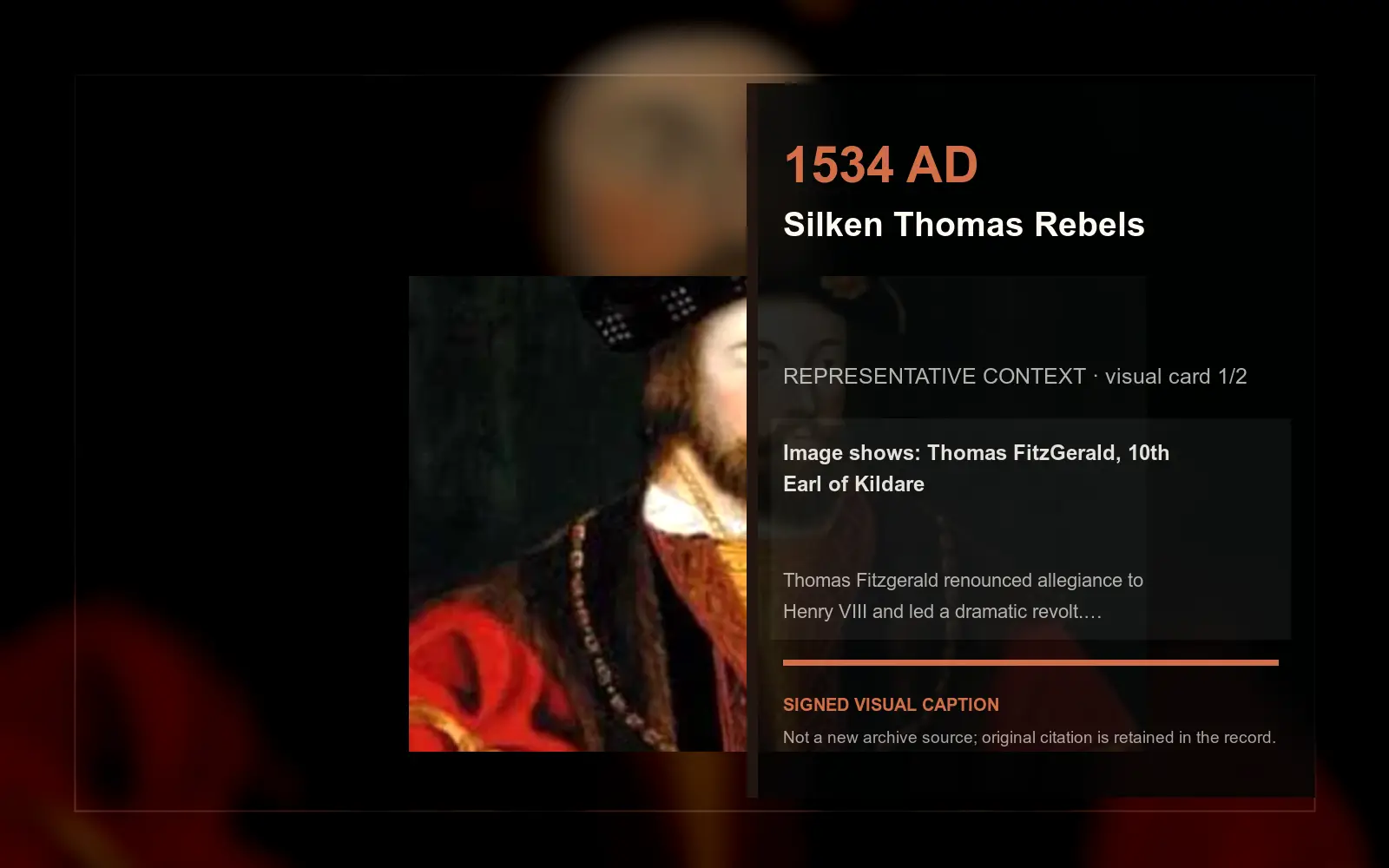
Why it matters
Force made visible
Evidence dossier
Read this moment as a hinge
2 minute source-led readForce changes the field
Read 1534 AD as a hinge, not a label. Thomas Fitzgerald renounced allegiance to Henry VIII and led a dramatic revolt. That places “Silken Thomas Rebels” between “Poynings' Law Locks Parliament” and “The Dissolution Reaches Ireland”, while land, law, confession and settlement were being locked together into a durable order.
Follow the material pressure
Bring the frame down to one life in Dublin and Leinster: someone calculating risk with incomplete information and irreversible stakes. The public event is the visible surface; underneath it sits organisation, logistics, targets and the political consequences of violence, intersecting with land, food, wages, rent, trade and debt beneath the public argument.
What this changes next
Its collapse crushed Kildare power and pushed the Tudor crown toward a far more direct conquest of Ireland. Its importance lies in the altered field it leaves behind: the next actors inherit different risks, institutions and choices. Remove this record and the move from “Poynings' Law Locks Parliament” to “The Dissolution Reaches Ireland” becomes much harder to explain.
Unexpected angle“Thomas FitzGerald, 10th Earl of Kildare” is presented through an editorial composite derived from a catalogued visual source. Treat the design as an invitation, not evidence: verify the historical claim in the source ledger and use the constructed frame to ask what no surviving image can show.
Source ledger