Evidence record · Irish ports and rural districts
1846 ADFood Continues to Move through Irish Ports
Grain and livestock still entered trade while the poor lacked purchasing power. The contrast became a lasting moral and political argument about the state’s response.
Open the interactive frame→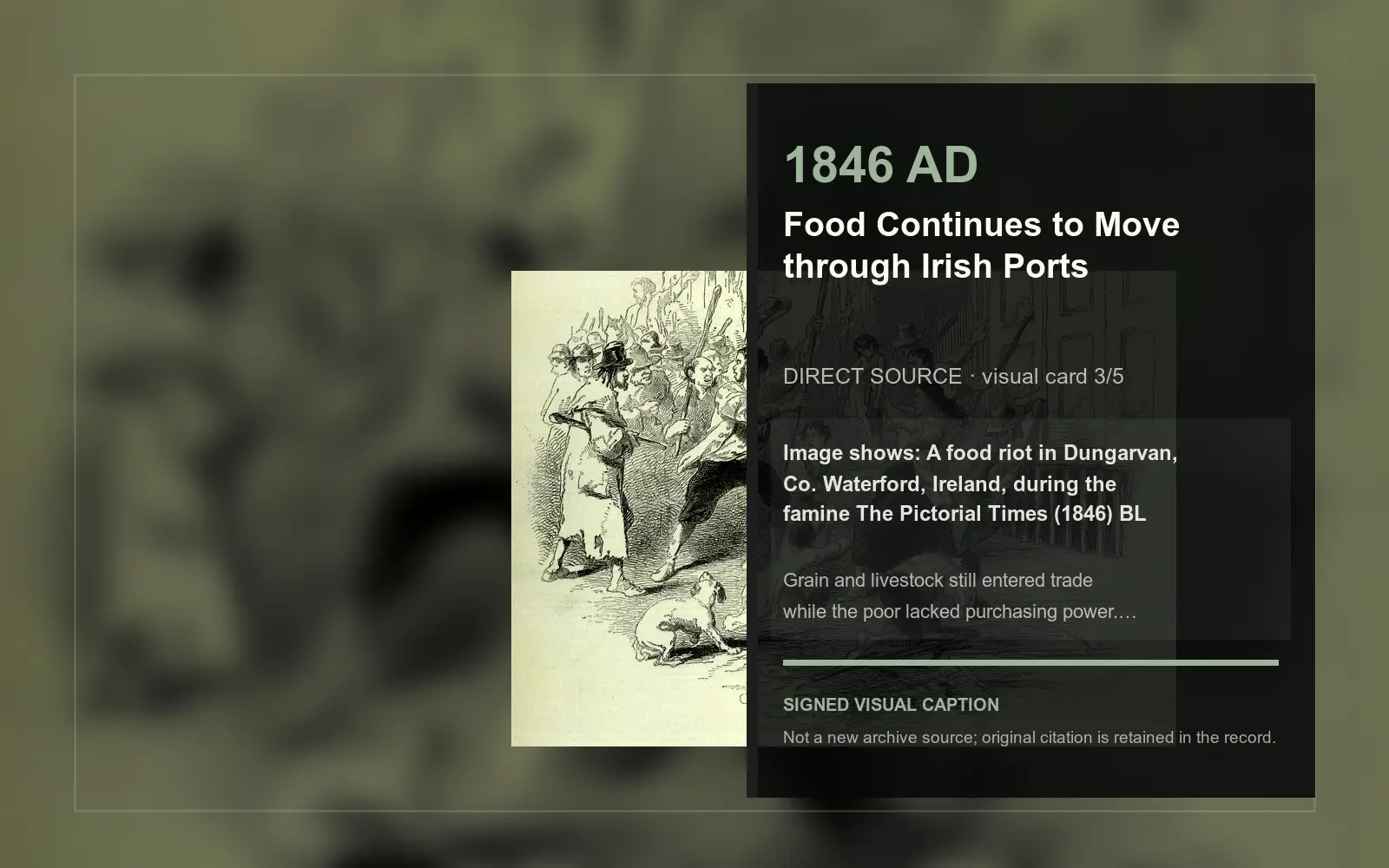
Why it matters
Economic life made visible
Evidence dossier
Read this moment as a hinge
2 minute source-led readFollow the material pressure
Read 1846 AD as a hinge, not a label. Grain and livestock still entered trade while the poor lacked purchasing power. That places “Food Continues to Move through Irish Ports” between “Maize Becomes “Peel’s Brimstone”” and “Public Works Enrolment Surges”, while hunger, relief, eviction and emigration turned policy into a test measured in human survival.
One event, incompatible memories
Bring the frame down to one life in Irish ports and rural districts: a household balancing survival against rules made elsewhere. The public event is the visible surface; underneath it sits land, food, wages, rent, trade and debt beneath the public argument, intersecting with commemoration, silence and the politics of whose account becomes official.
What this changes next
The contrast became a lasting moral and political argument about the state’s response. Its importance lies in the altered field it leaves behind: the next actors inherit different risks, institutions and choices. Remove this record and the move from “Maize Becomes “Peel’s Brimstone”” to “Public Works Enrolment Surges” becomes much harder to explain.
Unexpected angle“A food riot in Dungarvan, Co. Waterford, Ireland, during the famine The Pictorial Times…” is presented through an editorial composite derived from a catalogued visual source. Treat the design as an invitation, not evidence: verify the historical claim in the source ledger and use the constructed frame to ask what no surviving image can show.
Source ledger