Evidence record · Grosse Île, Canada
1847 ADGrosse Île Becomes a Quarantine Graveyard
Ships carrying Irish emigrants reached the Canadian quarantine station with typhus aboard. Thousands died at sea or after arrival, including medical staff and local caregivers.
Open the interactive frame→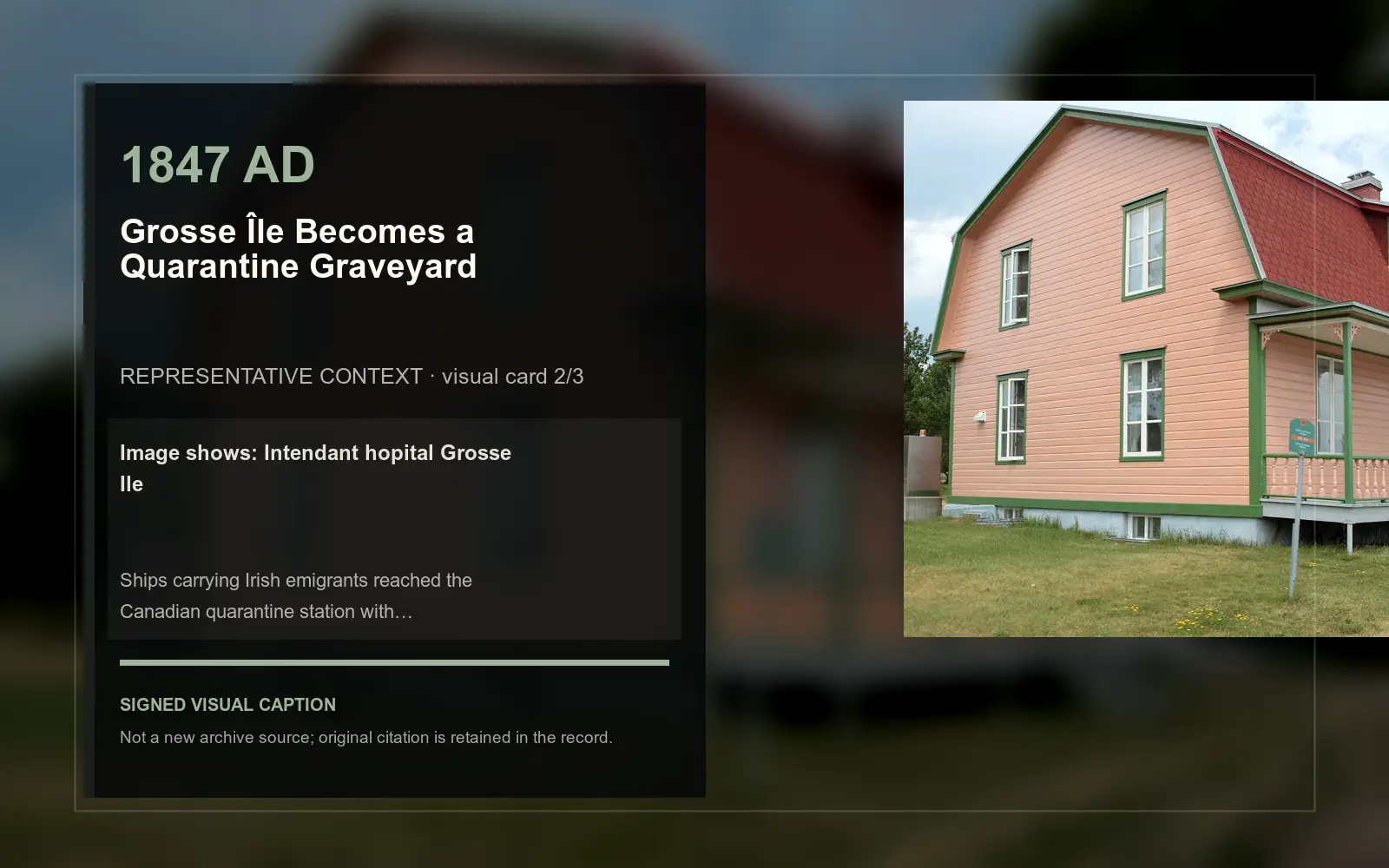
Why it matters
Movement made visible
Evidence dossier
Read this moment as a hinge
2 minute source-led readA route becomes evidence
Read 1847 AD as a hinge, not a label. Ships carrying Irish emigrants reached the Canadian quarantine station with typhus aboard. That places “Grosse Île Becomes a Quarantine Graveyard” between “Public Works Are Closed” and “Liverpool Struggles with Mass Arrival”, while hunger, relief, eviction and emigration turned policy into a test measured in human survival.
Vulnerability becomes political
Bring the frame down to one life in Grosse Île, Canada: a person turning a political or economic crisis into a decision about distance. The public event is the visible surface; underneath it sits departure, exile, displacement, return and the networks that make movement possible, intersecting with disease, hunger, care, burial and the capacity of public relief.
What this changes next
Thousands died at sea or after arrival, including medical staff and local caregivers. Its importance lies in the altered field it leaves behind: the next actors inherit different risks, institutions and choices. Remove this record and the move from “Public Works Are Closed” to “Liverpool Struggles with Mass Arrival” becomes much harder to explain.
Unexpected angle“Intendant hopital Grosse Ile” is presented through an editorial composite derived from a catalogued visual source. Treat the design as an invitation, not evidence: verify the historical claim in the source ledger and use the constructed frame to ask what no surviving image can show.
Source ledger