Evidence record · Connacht and western Munster
1849 ADThe West Remains in Acute Distress
Crop recovery was uneven, and western unions carried heavy debt with little rateable wealth. Regional concentration explains why a national end date can hide continuing local catastrophe.
Open the interactive frame→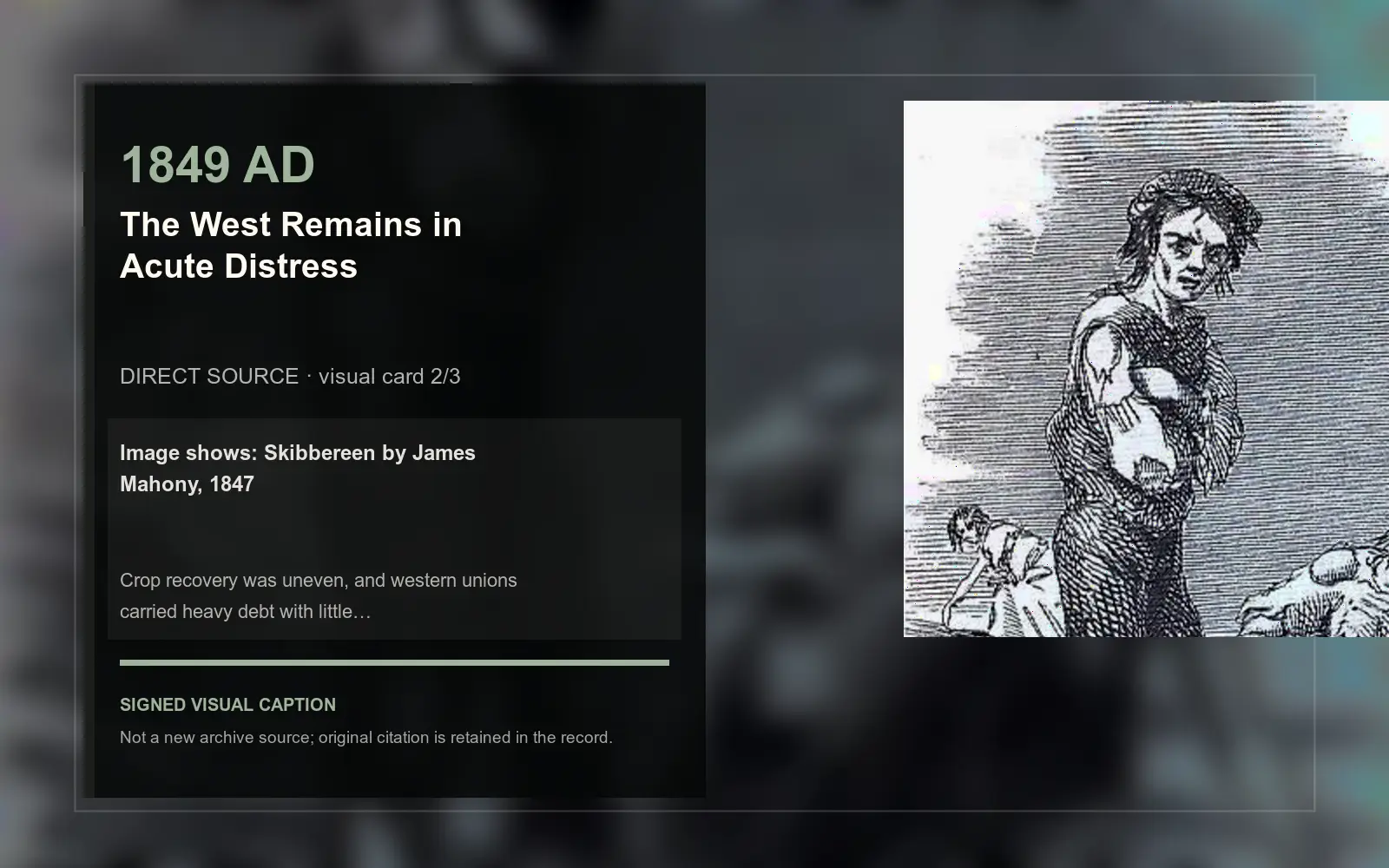
Why it matters
Place made visible
Evidence dossier
Read this moment as a hinge
2 minute source-led readPlace is part of the cause
Read 1849 AD as a hinge, not a label. Crop recovery was uneven, and western unions carried heavy debt with little rateable wealth. That places “The West Remains in Acute Distress” between “Assisted Emigration Becomes Estate Policy” and “The Encumbered Estates Act Changes Ownership”, while hunger, relief, eviction and emigration turned policy into a test measured in human survival.
The social contract shifts
Bring the frame down to one life in Connacht and western Munster: a resident for whom the national story arrives with a distinctly local shape. The public event is the visible surface; underneath it sits geography, local networks and the uneven reach of island-wide power, intersecting with class, family, welfare, identity and the rules that organise belonging.
What this changes next
Regional concentration explains why a national end date can hide continuing local catastrophe. Its importance lies in the altered field it leaves behind: the next actors inherit different risks, institutions and choices. Remove this record and the move from “Assisted Emigration Becomes Estate Policy” to “The Encumbered Estates Act Changes Ownership” becomes much harder to explain.
Unexpected angle“Skibbereen by James Mahony, 1847” is presented through an editorial composite derived from a catalogued visual source. Treat the design as an invitation, not evidence: verify the historical claim in the source ledger and use the constructed frame to ask what no surviving image can show.
Source ledger