Evidence record · Dublin
1913 ADDublin Lockout
Workers led by James Larkin faced employers and police in one of Ireland’s fiercest labour conflicts. The Lockout exposed a city of poverty behind the grandeur of empire and commerce.
Open the interactive frame→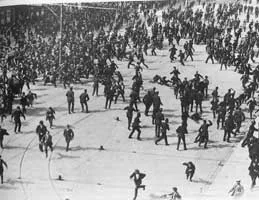
Why it matters
Economic life made visible
Evidence dossier
Read this moment as a hinge
2 minute source-led readFollow the material pressure
Read 1913 AD as a hinge, not a label. Workers led by James Larkin faced employers and police in one of Ireland’s fiercest labour conflicts. That places “Dublin Lockout” between “The Ulster Volunteer Force Forms” and “The Irish Volunteers Assemble”, while parliamentary manoeuvre, mass organisation and land pressure were competing to define representation.
Put one person in the frame
Bring the frame down to one life in Dublin: a household balancing survival against rules made elsewhere. The public event is the visible surface; underneath it sits land, food, wages, rent, trade and debt beneath the public argument.
What this changes next
The Lockout exposed a city of poverty behind the grandeur of empire and commerce. Its importance lies in the altered field it leaves behind: the next actors inherit different risks, institutions and choices. Remove this record and the move from “The Ulster Volunteer Force Forms” to “The Irish Volunteers Assemble” becomes much harder to explain.
Unexpected angle“English Wikipedia: 1913lockout” is a direct archival trace, but it is still an argument made by framing. Ask what sits outside the image before treating visibility as completeness.
Source ledger