Evidence record · Belfast and Northern Ireland
1968 ADO’Neill Announces a Reform Programme
The Northern Ireland government proposed changes to housing allocation, complaints procedures and local voting. Reform satisfied neither civil-rights activists nor hard-line unionist opponents.
Open the interactive frame→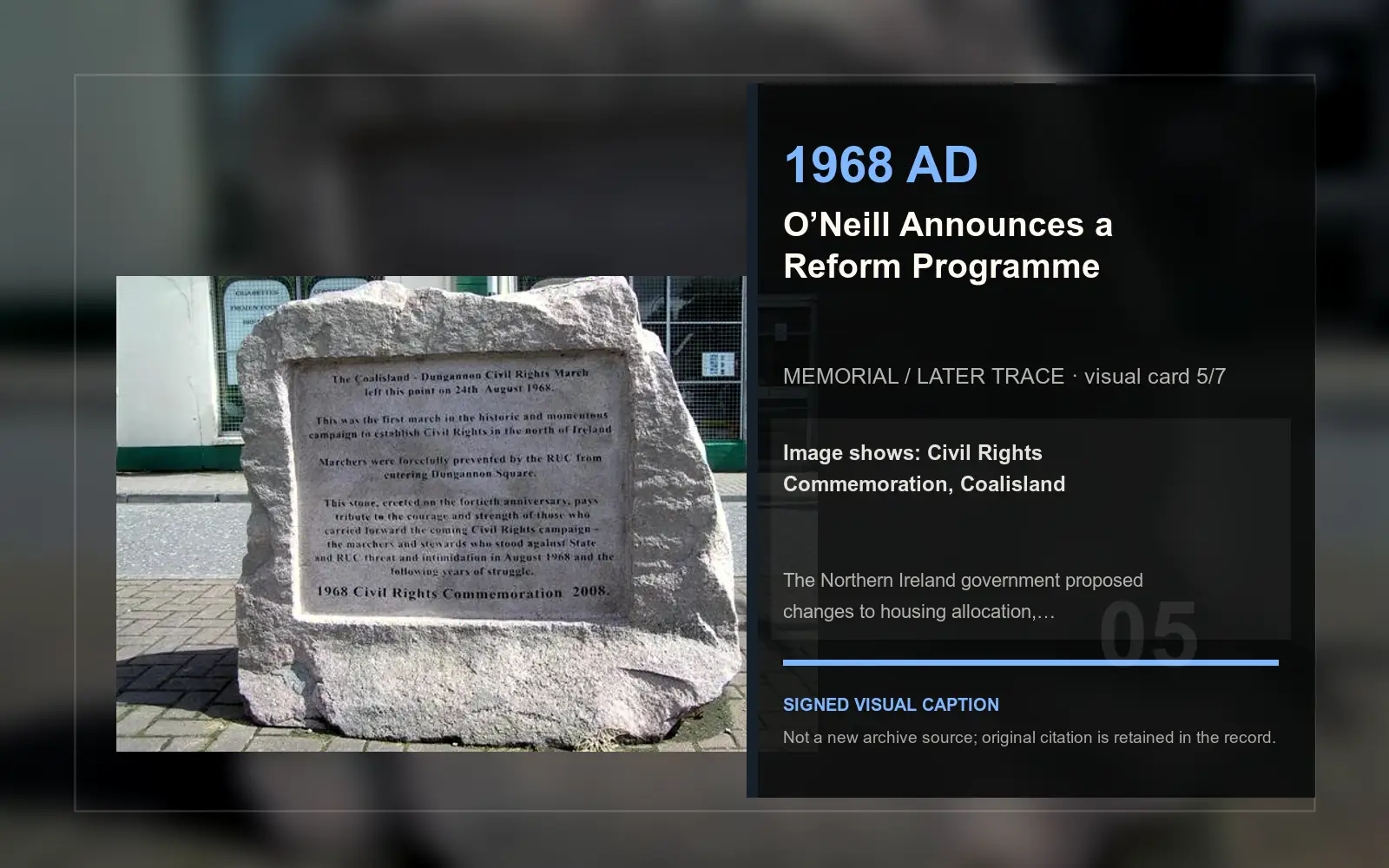
Why it matters
Government made visible
Evidence dossier
Read this moment as a hinge
2 minute source-led readPower becomes procedure
Read 1968 AD as a hinge, not a label. The Northern Ireland government proposed changes to housing allocation, complaints procedures and local voting. That places “O’Neill Announces a Reform Programme” between “Police Attack the Derry March” and “Burntollet Deepens the Civil-Rights Crisis”, while immediate harm and the longer construction of consent, accountability and peace had to be held in the same frame.
A private grievance becomes public
Bring the frame down to one life in Belfast and Northern Ireland: the person at the desk—or across it—where policy becomes an instruction. The public event is the visible surface; underneath it sits offices, law, taxation and bureaucracy turning a decision into daily reality, intersecting with rights, discrimination, organisation and the legitimacy of the state response.
What this changes next
Reform satisfied neither civil-rights activists nor hard-line unionist opponents. Its importance lies in the altered field it leaves behind: the next actors inherit different risks, institutions and choices. Remove this record and the move from “Police Attack the Derry March” to “Burntollet Deepens the Civil-Rights Crisis” becomes much harder to explain.
Unexpected angle“Civil Rights Commemoration, Coalisland” is presented through an editorial composite derived from a catalogued visual source. Treat the design as an invitation, not evidence: verify the historical claim in the source ledger and use the constructed frame to ask what no surviving image can show.
Source ledger