Evidence record · Northern Ireland
1993 ADHume–Adams Dialogue Reframes Republican Strategy
John Hume and Gerry Adams pursued private discussions about self-determination, consent and an end to violence. Critics disputed the contacts, but they helped shape later public formulas.
Open the interactive frame→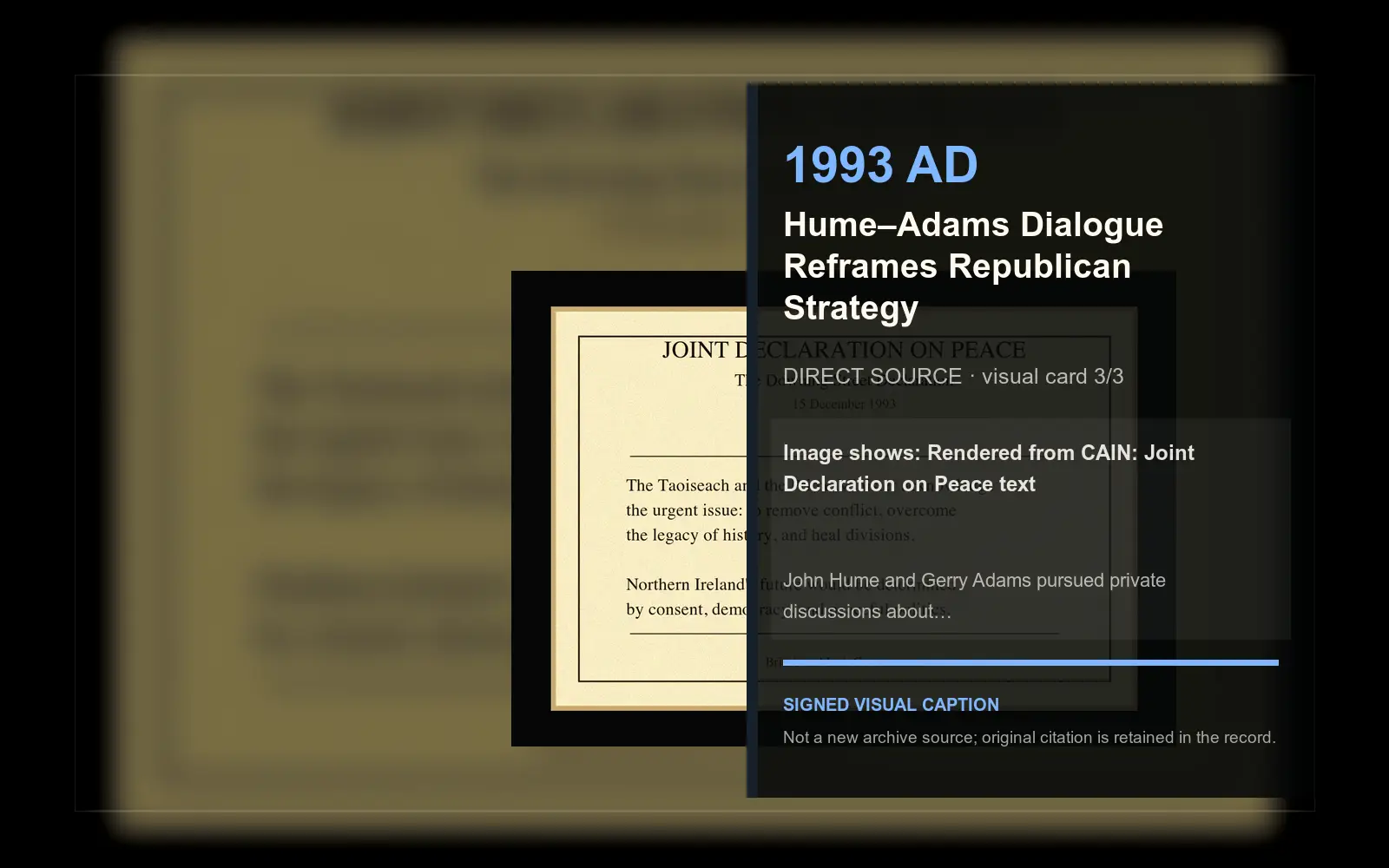
Why it matters
Power made visible
Evidence dossier
Read this moment as a hinge
2 minute source-led readThe rulebook moves
Read 1993 AD as a hinge, not a label. John Hume and Gerry Adams pursued private discussions about self-determination, consent and an end to violence. That places “Hume–Adams Dialogue Reframes Republican Strategy” between “Downing Street Declaration” and “IRA Ceasefire Opens a Door”, while immediate harm and the longer construction of consent, accountability and peace had to be held in the same frame.
One event, incompatible memories
Bring the frame down to one life in Northern Ireland: a person discovering that the same vote, oath or border now carries a different meaning. The public event is the visible surface; underneath it sits representation, sovereignty and the institutions entitled to make binding decisions, intersecting with commemoration, silence and the politics of whose account becomes official.
What this changes next
Critics disputed the contacts, but they helped shape later public formulas. Its importance lies in the altered field it leaves behind: the next actors inherit different risks, institutions and choices. Remove this record and the move from “Downing Street Declaration” to “IRA Ceasefire Opens a Door” becomes much harder to explain.
Unexpected angle“Rendered from CAIN: Joint Declaration on Peace text” is presented through an editorial composite derived from a catalogued visual source. Treat the design as an invitation, not evidence: verify the historical claim in the source ledger and use the constructed frame to ask what no surviving image can show.
Source ledger